The work that
shouldn't still be
done by hand
I build the system that does it instead, and hand over the drawing, the credentials, and the thing already running. Two of them are on this page — one answering a chartered accountancy practice's clients every day, one letting people query a production database without being able to damage it.
Tell me what's in the way. If I'm the wrong person I'll say so on the call rather than after the invoice.
What changes after
- 01
Your clients stop waiting for someone to be free
Every enquiry answered in seconds, on WhatsApp or email, with that client's own filing status and outstanding documents already in the reply. Strangers get qualified and scored instead of sitting in an inbox.
See SHEET 02
- 02
Deadlines stop depending on somebody remembering
Filing dates chase themselves at seven days, three days, one day, and then daily once they are late. Documents and unpaid invoices chase themselves too. A partner is paged only when something is genuinely stuck.
See SHEET 02
- 03
Nobody needs to know SQL to know the numbers
Ask in plain English, get the answer, the chart, and the query itself. Anything that writes stops at an approval gate first, so the person asking can never break what they are asking about.
See SHEET 03
- 04
The bill for running all of it stops being a surprise
Cheap questions stop reaching an expensive model, paraphrased repeats never reach the API at all, and there is enough instrumentation to show the spend actually moved rather than asserting it.
See SHEET 04
CA Firm Automation Suite
Sold to a chartered accountancy practice in Hyderabad
A practice's whole client-facing surface — questions, documents, deadlines, invoices — running as one workflow instead of as somebody's afternoon.
- 152
- nodes
- 238
- links
- 9
- entry points
- 5
- use cases
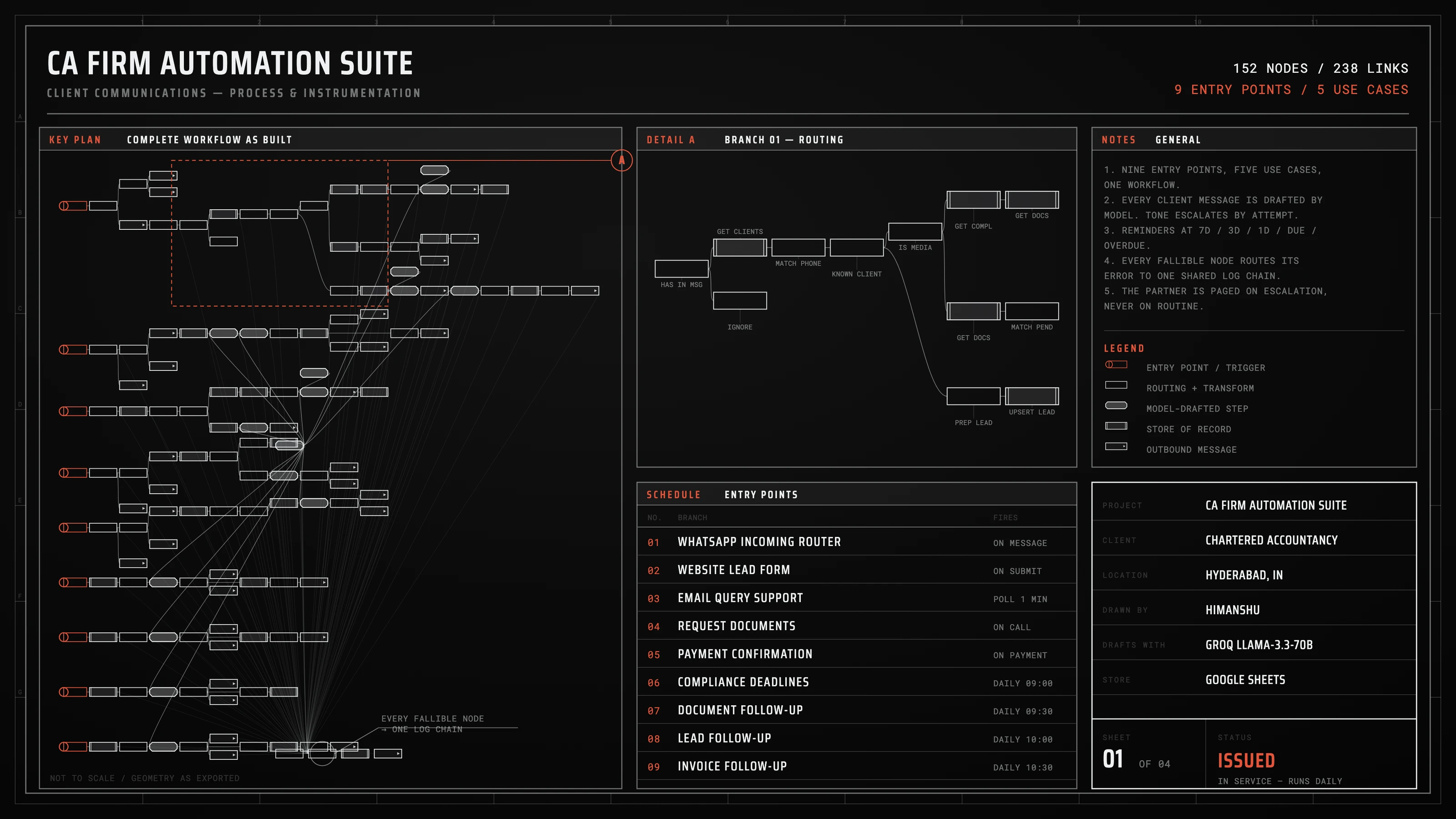
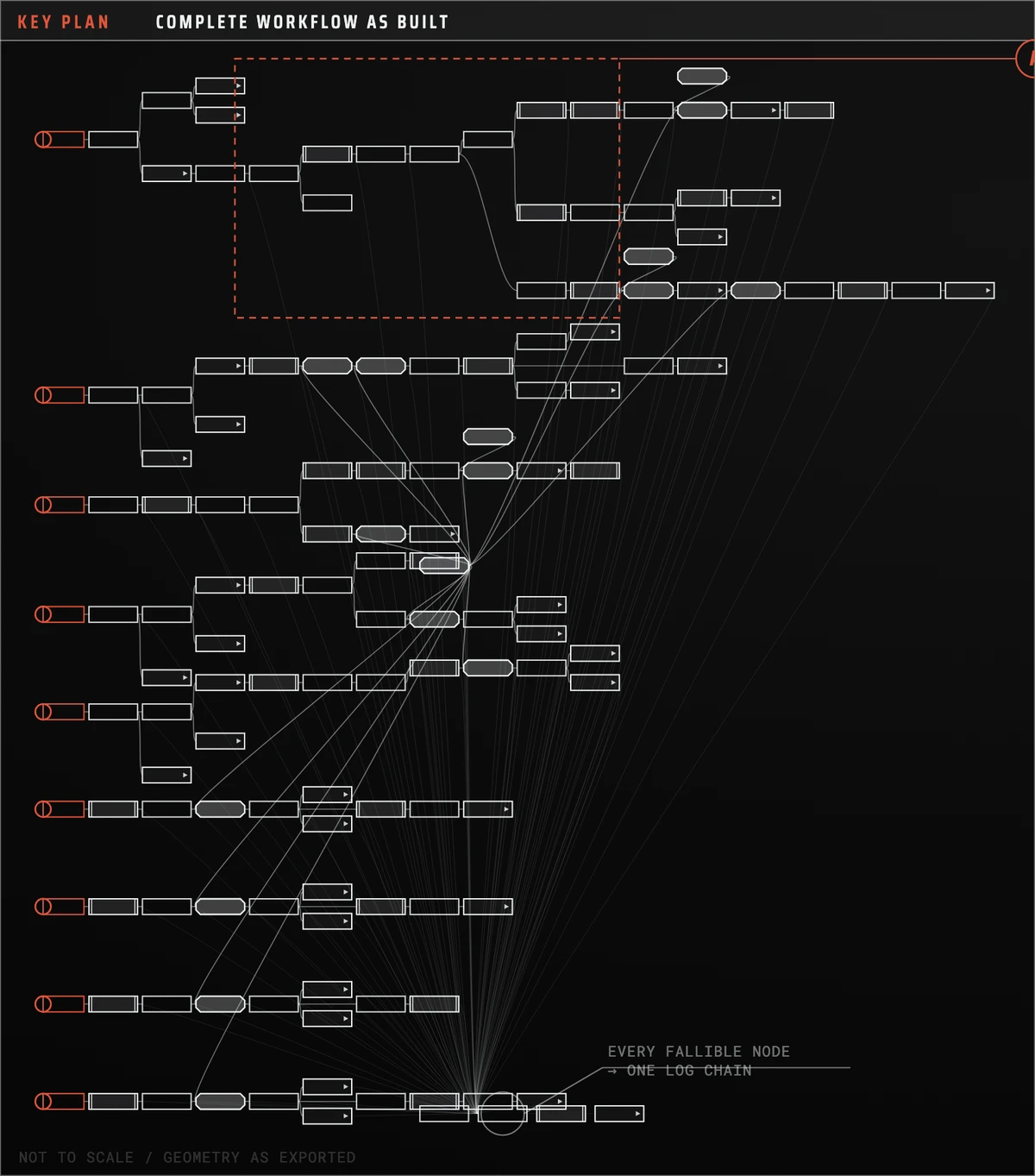
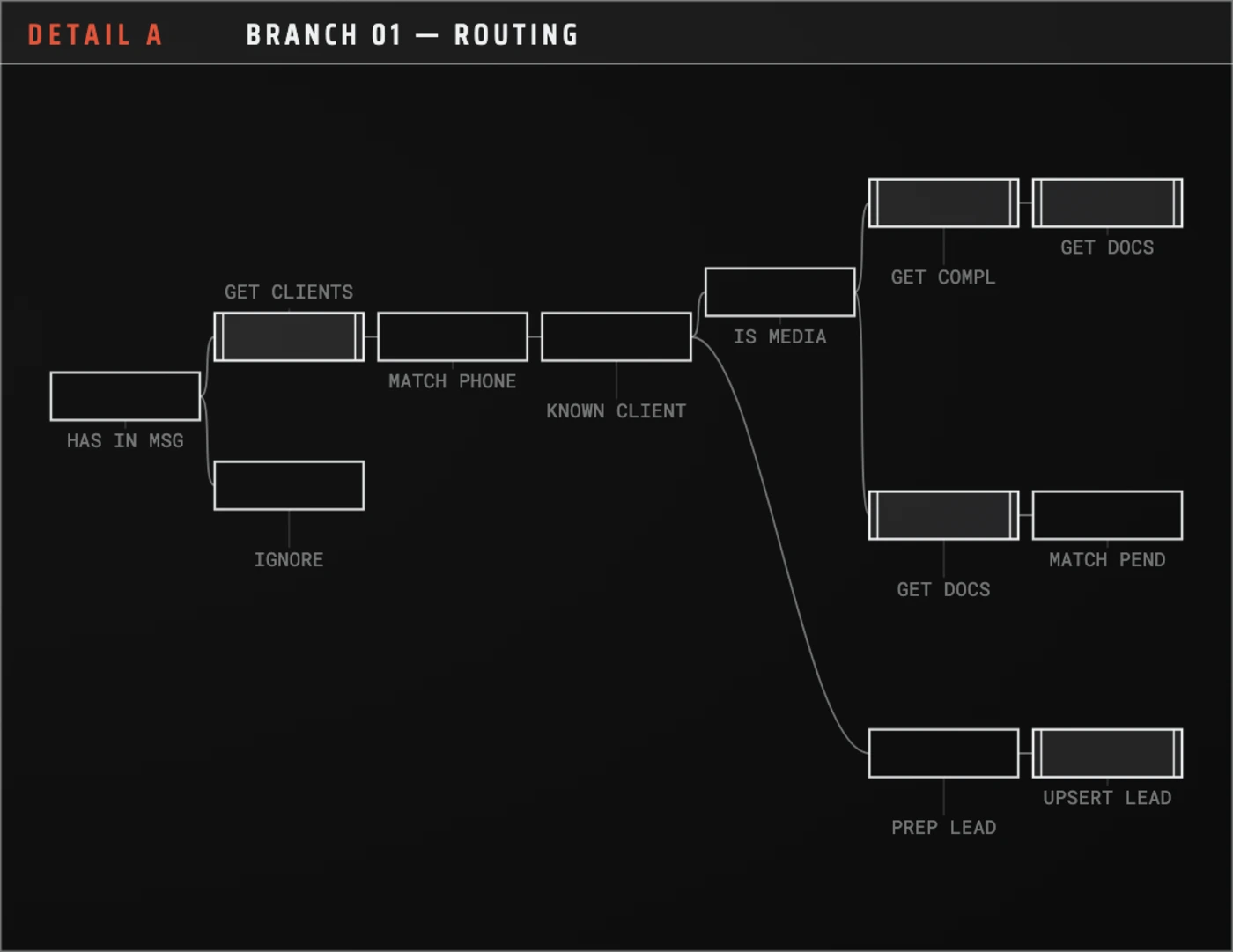
The drawing is generated from the workflow file itself — every node sits at its real position, every line is a real connection. It cannot drift from what was delivered.
- Reaches clients on
- WhatsApp · Email · Telegram
- Drafts with
- Groq llama-3.3-70b
- Store of record
- Google Sheets
- Failure design
- every fallible node into one log chain
What it does while nobody is watching
- 09:00
Compliance deadlines
GST, ITR, TDS and ROC dates checked against every client. Reminders go out at 7, 3 and 1 days; tone escalates on its own once a date passes. More than three days overdue pages the partner.
- 09:30
Document follow-up
Anything still marked pending for three days gets asked for again, worded a little more firmly each time. The third ask copies the partner in.
- 10:00
Lead follow-up
Open leads get nudged on their due date and rescheduled three days out. After four attempts with no movement they close themselves as cold.
- 10:30
Invoice follow-up
Unpaid invoices step through upcoming, due, and progressively later reminders. Past fifteen days it flags as escalated and pages the partner.
DBQuery
Natural language in, checked SQL out
A database anyone in the room can interrogate, and nobody in the room can damage.
A question in plain English. No schema knowledge, no query builder.
- Loop
- ReAct — thought, action, observation, summary
- Transport
- server-sent events, streamed as it thinks
- Credentials
- AES-256-CBC at rest, JWT and role-gated
- Ships as
- web app and Tauri desktop
Revision history
Earlier work, most recent first
- D
Inference cost, in Rust
Open source
An open-source inference platform that classifies query complexity by embedding and routes on it, with an L1 Moka and L2 Redis semantic cache and a full Prometheus and Grafana stack behind it. The code is public.
- C
Search and agents in production
Tejas AI (YC W25)
Hybrid keyword and vector retrieval on OpenSearch over a corpus indexed from around sixty ATS platforms, and the WhatsApp agent in front of it — a router with specialist sub-agents and memory that survives across sessions.
- B
Research taken to production
AuraX
Co-founded AuraX as CTO. Diffusion-based virtual try-on incubated at IIIT-Hyderabad's CIE, carried from research through to production inference and into commercial deals with Aditya Birla Fashion Group and brands under Mensa Brands.
- A
Teaching at scale
SynthAiLabs
Founded SynthAiLabs and OpenEdu, which reached roughly eleven thousand registered students, and ran the OpenCodeDevelopers society for eight hundred more.
The longer record — projects, research, writing — is at /projects and /research.
Bring me the bottleneck
Fifteen minutes, no deck. Describe the thing that keeps costing someone an afternoon and I'll tell you straight whether it's worth automating, roughly what it takes, and whether I'm the right person for it. A paragraph by email works just as well if you'd rather write.
- Drawn by
- Himanshu
- Status
- Available for work
- Takes on
- Contract · retained · research
- Also open to
- Full-time engineering roles
- Based
- India — works remote